
Mosquito Bucket "Hack"
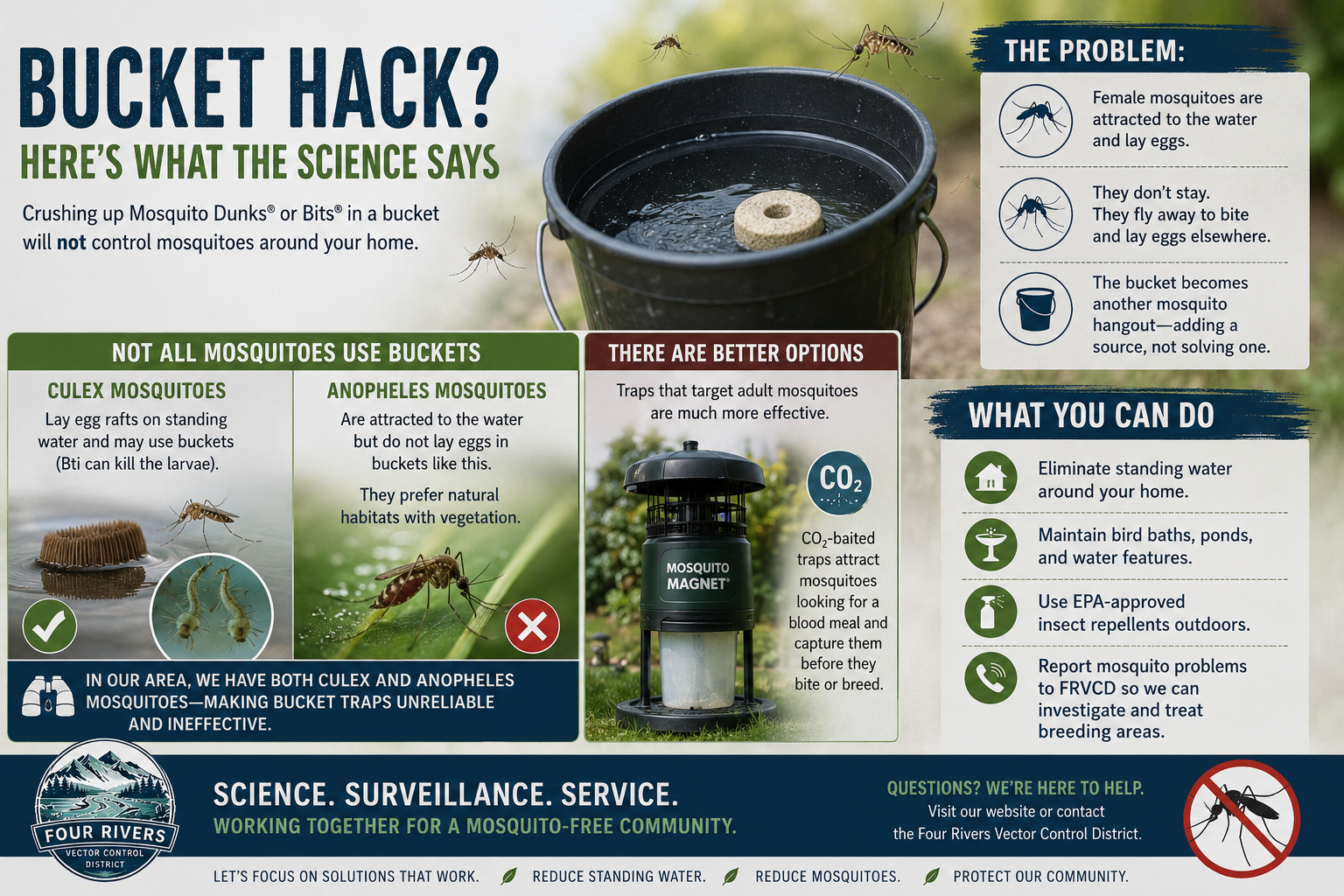
Mosquito Bucket "Hack" on YouTube? Here's What You Should Know
Every year, new mosquito control "hacks" make the rounds on social media. One of the latest trends encourages people to crush up Mosquito Dunks® or Mosquito Bits® (products containing the biological larvicide Bti) and place them in buckets of water to attract and kill mosquitoes.
While the idea sounds logical, it is not an effective way to reduce mosquito populations around your home.
How It Works
Female mosquitoes are naturally attracted to standing water where they can lay their eggs. When Bti is added to the water, mosquito larvae that hatch in that water are killed.
The problem is that the adult mosquito doesn't stay in the bucket.
After laying her eggs, she simply flies away—and may continue biting people and animals before laying eggs in additional locations.
In many cases, the bucket simply becomes another place that attracts mosquitoes to your yard without significantly reducing the number of biting adults.
Our Area Has Different Mosquito Species
One reason this "hack" is unreliable is because not all mosquito species lay their eggs the same way.
The Four Rivers Vector Control District commonly encounters both Culex mosquitoes and Anopheles mosquitoes.
- Culex mosquitoes lay egg rafts directly on standing water and may use a bucket containing Bti.
- Anopheles mosquitoes, while they may be attracted to the water and visit the bucket, generally do not use this type of container as a preferred egg-laying site. They often select more natural habitats with vegetation and specific water conditions.
Because Anopheles mosquitoes can still be attracted to the bucket but not lay eggs there, the bucket may simply become another place where adult mosquitoes congregate before flying off to bite people or continue breeding elsewhere.
In addition, some floodwater mosquito species lay their eggs on moist soil rather than directly on water, making bucket traps ineffective for those species as well.
Does It Reduce Mosquitoes?
Under very specific conditions, Bti can prevent mosquitoes from developing inside that one container. However, in a typical neighborhood, mosquitoes have countless other places to breed, including:
- Bird baths
- Clogged gutters
- Flower pot saucers
- Tree holes
- Irrigation runoff
- Flooded vegetation
- Ditches and wetlands
Simply eliminating standing water is usually far more effective than intentionally placing another bucket of water in your yard—even if that bucket contains Bti.
What Works Better?
If your goal is to reduce biting mosquitoes around your home, traps that actively target adult mosquitoes are much more effective.
Devices such as the Mosquito Magnet® and other CO₂-baited mosquito traps mimic human breath and attract mosquitoes looking for a blood meal. These traps capture adult mosquitoes before they can continue biting or reproduce and generally provide much better control than passive bucket traps.
Our Recommendation
The Four Rivers Vector Control District recommends using science-based mosquito control methods:
- Eliminate standing water whenever possible.
- Maintain bird baths, ponds, and water features properly.
- Use EPA-approved insect repellents when outdoors.
- Consider a quality CO₂-baited mosquito trap if mosquito activity is consistently high.
- Report mosquito problems to the District so we can investigate and treat breeding areas when appropriate.
Social media can be a great place to discover new ideas, but not every mosquito "hack" is supported by science. If you have questions about something you've seen online, we're always happy to help separate fact from fiction and recommend control methods that are proven to work.